Who Did Jesus Christ Claim to Be?
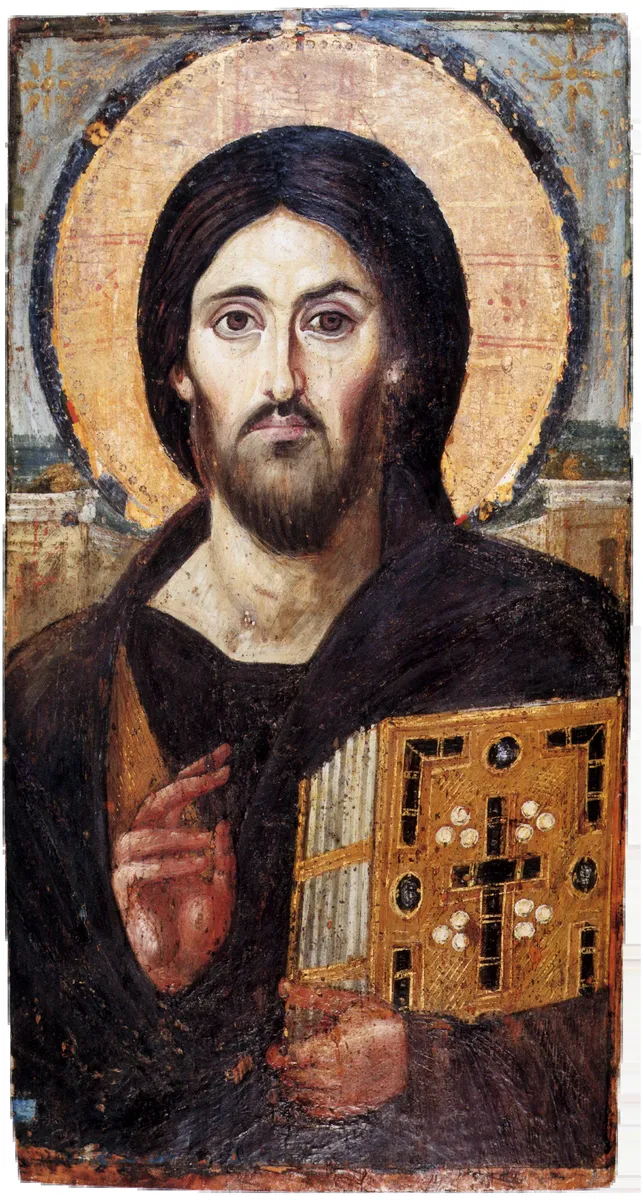
Christ Pantocrator, sixth-century encaustic icon preserved at Saint Catherine’s Monastery, Sinai. It is an early Christian representation of Christ, not a portrait made during His earthly life.
Short Answer
Jesus Christ did not present Himself merely as a prophet, moral teacher, religious reformer or one messenger of God among many. According to the Gospels, He claimed to be the Christ—the promised Messias; the unique Son of God; the heavenly Son of Man foretold by Daniel; the One possessing authority to forgive sins, give eternal life and judge mankind; and the One who existed before Abraham and shared glory with the Father before the creation of the world.
He required faith in Himself, claimed an extraordinary unity with the Father, and accepted from St Thomas the confession: “My Lord, and my God.”
It is true that the Gospels do not record Jesus walking into a crowd and saying in the modern formula, “I am God.” But that is too narrow a test. Jesus spoke within a first-century Jewish religious setting. His identity is disclosed through the titles He accepted, the authority He claimed, the works He attributed to Himself, His relationship with the Father, and statements such as “I and the Father are one” and “Before Abraham was made, I am.”
His opponents understood the gravity of these claims: on more than one occasion they accused Him of blasphemy or attempted to stone Him.
The Catholic Church therefore did not invent Christ's divinity centuries later. The Councils of Nicaea and Chalcedon gave precise doctrinal language to what the Church had received: Jesus Christ is true God and true man, the eternal Son, consubstantial with the Father according to His divinity, possessing a complete human nature, the two natures united in the one divine Person of the Son. These are defined doctrines of the Catholic Faith. (New Advent)
The real question raised by the Gospels is therefore not simply whether Jesus was a good teacher. It is whether His extraordinary claims were true.
Why This Question Matters
Almost everything in Christianity depends upon the answer.
If Jesus were merely a wise rabbi who was later transformed by His followers into a divine figure, then Christianity's central worship of Christ would be radically mistaken. The doctrines of the Incarnation, Redemption, Trinity and Christ's universal kingship would rest upon a later distortion of the historical Jesus.
But if Jesus truly is who He claimed to be, then His teaching cannot reasonably be placed alongside that of other religious teachers as merely one spiritual opinion among many. When Christ says, “I am the way, and the truth, and the life. No man cometh to the Father, but by me,” He presents Himself as personally indispensable to man's reconciliation with God.
This question also follows naturally from the preceding questions in this series. If there are good grounds for believing that Jesus really existed and that the Gospels are historically trustworthy, the next question is unavoidable:
What do those Gospels actually tell us Jesus believed and claimed about Himself?
The answer is considerably more radical than “He was a good man who taught people to love one another.”
What the Catholic Church Teaches
Jesus Is the Christ and Son of the Living God
At Caesarea Philippi, Christ asked His Apostles the question at the heart of this article:
“But whom do you say that I am?”
St Peter replied:
“Thou art Christ, the Son of the living God.”
Jesus did not correct Peter or reduce the statement to something less exalted. He declared Peter blessed because this truth had been revealed to him by the Father. — Matthew 16:15–17.
“Christ” means the Anointed One, the promised Messias. Jesus therefore accepted Peter's identification of Him as the long-awaited Christ.
But the Gospel evidence goes beyond Messiahship alone.
Jesus Claimed the Identity of the Danielic Son of Man
One of the clearest scenes occurs at Christ's trial before the high priest.
He was asked:
“Art thou the Christ the Son of the blessed God?”
Jesus answered:
“I am.”
He then declared that they would see the Son of Man sitting at God's right hand and coming with the clouds of heaven. The high priest immediately tore his garments and declared that blasphemy had been spoken. — Mark 14:61–64.
The importance of “Son of Man” here becomes clearer when compared with Daniel 7. Daniel had seen:
“one like the son of man”
coming “with the clouds of heaven”, receiving power, glory and an everlasting kingdom in which all peoples and nations serve him.
Jesus was therefore not simply using “son of man” to mean “a human being.” In the trial scene He deliberately invokes Daniel's heavenly figure and applies that prophecy to Himself.
This is particularly important because Mark is one of the Synoptic Gospels. The claim that Christ's exalted identity exists only in St John's Gospel cannot account adequately for this passage.
Jesus Claimed Authority to Forgive Sins
In Mark 2, a paralytic was brought before Christ. Instead of beginning by healing his body, Jesus told him that his sins were forgiven.
The scribes immediately reasoned:
“Who can forgive sins, but God only?”
Jesus knew their thoughts. He did not answer that they had misunderstood His authority. Instead He healed the man precisely “that you may know that the Son of man hath power on earth to forgive sins.”
A prophet can announce God's forgiveness. Christ acts with personal authority to remit the man's sins and then performs a miracle as the visible confirmation of that authority.
This does not stand alone as a mathematical proof of the Incarnation. But within the cumulative Gospel portrait it is significant: Jesus repeatedly acts with prerogatives belonging uniquely to God.
Jesus Claimed the Divine Works of Giving Life and Judging Mankind
John 5 contains an even more extraordinary claim.
After Christ called God His Father, St John records that His hearers understood Him as “making himself equal to God.” Jesus then continued rather than withdrawing the claim.
He attributed to the Son works belonging to God:
the Father raises the dead, and the Son likewise gives life to whom He wills;
all judgment has been entrusted to the Son;
men must honour the Son as they honour the Father;
the dead will hear the voice of the Son of God and rise.
The cumulative force is difficult to reduce to the claim of an ordinary prophet. Prophets direct men toward God. Christ places mankind's eternal destiny in relation to Himself.
“I and the Father Are One”
In John 10 Christ declares that He gives His sheep eternal life and that no one can take them from His hand. He then says:
“I and the Father are one.”
His hearers took up stones. When Jesus asked why, they replied that it was because:
“thou, being a man, maketh thyself God.”
Christ does not respond by saying, “You have misunderstood me; I meant only that I agree morally with God.” He continues by calling Himself the Son of God and asserting the mutual indwelling of Father and Son: “the Father is in me, and I in the Father.”
The passage must nevertheless be interpreted with Trinitarian precision. Catholic doctrine does not mean that Jesus is the Father. The Father and Son are distinct divine Persons. They are one in the undivided divine nature.
St Augustine made exactly this distinction when commenting on the passage: the plural “are” preserves the distinction of Persons while the “one” expresses their equality and unity of nature. (New Advent)
“Before Abraham Was Made, I Am”
John 8 provides another remarkable statement.
Jesus tells His opponents:
“Before Abraham was made, I am.”
They immediately take up stones.
At a minimum, the statement claims a mode of personal existence preceding Abraham by many centuries. But the unusual present tense—I am, rather than merely I was—was understood by the Catholic Fathers as having deeper significance.
St Augustine comments:
“Recognize the Creator — distinguish the creature.”
He explains that Abraham was made, whereas Christ says “I am”, relating the expression to Christ's divine and uncreated being. (New Advent)
Care is useful here. John 8:58 should not simplistically be described as a verbatim quotation of the Greek form of Exodus 3:14; the expressions are not verbally identical in every respect. The stronger argument is the actual Johannine context: Christ asserts pre-existence before Abraham in the present tense, followed immediately by an attempted stoning, and the Fathers interpreted the passage in accordance with His divine eternity.
Jesus Claimed Pre-existence Before Creation
The claim goes further in Christ's prayer to the Father:
“glorify thou me, O Father, with thyself, with the glory which I had, before the world was, with thee.” — John 17:5.
This is not merely foreordination in the mind of God. Jesus speaks of glory which He possessed with the Father before the world existed.
The same discourse distinguishes the Father from the Son while placing Christ in a relationship with the Father unlike that of any created prophet.
Jesus Required Faith in Himself
At the Last Supper Christ says:
“You believe in God, believe also in me.”
He then declares:
“I am the way, and the truth, and the life.”
And when Philip asks to see the Father, Christ answers that whoever has seen Him has seen the Father, explaining that He is in the Father and the Father in Him.
Again, Catholic doctrine does not interpret this as meaning that Father and Son are the same Person. Rather, the Son perfectly possesses the one divine nature and perfectly reveals the Father.
Jesus Accepted Worship and the Confession “My Lord and My God”
After the Resurrection, St Thomas encountered the risen Christ and said:
“My Lord, and my God.”
Jesus did not rebuke Thomas for idolatry. Instead He praised the faith involved and blessed those who would believe without seeing. St John immediately explains that his Gospel has been written so that its readers may believe that Jesus is the Christ, the Son of God, and have life in His name.
At the end of St Matthew's Gospel, the disciples likewise adore the risen Christ. He declares that all power in heaven and earth belongs to Him and commands baptism “in the name of the Father, and of the Son, and of the Holy Ghost.”
The Son is thus placed with the Father and Holy Ghost under the singular “name” into which all nations are to be baptized.
Historical and Theological Evidence
The Case Does Not Depend Upon One Isolated Verse
One of the weakest ways to argue for Christ's divinity is to find a single phrase and treat everything as dependent upon it. The Gospel evidence is stronger because it is cumulative.
Jesus presents Himself as:
the promised Christ;
the unique Son of the Father;
the Danielic Son of Man who receives everlasting dominion;
possessing authority to forgive sins;
giver of eternal life;
universal judge of mankind;
worthy of the honour given to the Father;
existing before Abraham;
possessing glory with the Father before creation;
uniquely one with and in the Father;
the sole way to the Father;
the object of faith and worship.
No single title needs to bear the whole argument.
For example, the expression “Son of God” should not be treated as though the words automatically prove full divinity every time they appear. Their meaning must be established by context. But when Christ's Sonship is combined with His claimed pre-existence, divine works, power to give eternal life, equality of honour with the Father, and unity with Him, the meaning becomes substantially clearer.
The Trial of Jesus Is Especially Significant
Mark 14 is one of the most important passages because the issue is presented under oath before the Jewish authorities.
Jesus is directly asked whether He is the Christ, the Son of the Blessed. He answers affirmatively and immediately invokes the heavenly Son of Man of Daniel 7.
The reaction is not evidence by itself that the high priest's theological interpretation must be correct. Opponents can misunderstand a speaker. But here the reaction matters because Jesus does not correct the alleged misunderstanding. The accusation of blasphemy follows His own solemn answer, and that answer combines Messiahship, divine Sonship, the throne at God's right hand and the Danielic coming on the clouds.
This makes it very difficult to reduce the Synoptic Jesus to a merely human ethical teacher.
Nicaea Defined the Meaning of Christ's Divinity
The First Council of Nicaea in A.D. 325 did not meet to decide for the first time whether Christians should begin treating Jesus as divine. It addressed the Arian controversy concerning how the Son relates to the Father.
Its Creed confesses the Son as:
“very God of very God, begotten not made”
and consubstantial—homoousios—with the Father. (New Advent)
“Consubstantial” means that the Son possesses the same divine nature or substance as the Father. He is not the highest creature. He is not a lesser god. He is eternally God.
This is defined Catholic doctrine.
Chalcedon Clarified Who the Incarnate Christ Is
The Council of Chalcedon in A.D. 451 addressed a different question: if Christ is both divine and human, how are His divinity and humanity related?
The Council defined one and the same Jesus Christ as:
“perfect in Godhead and perfect in manhood”
and as truly God and truly man, consubstantial with the Father according to divinity and consubstantial with us according to humanity. The two natures remain distinct without confusion or separation, united in one Person. (New Advent)
Thus Catholic doctrine rejects several distortions at once.
Jesus is not a man who later became God.
He is not a human person adopted by God.
He is not half God and half man.
His humanity is not an illusion.
His human nature is not absorbed into His divinity.
He is the eternal divine Person of the Son who truly assumed a complete human nature.
The Roman Catechism
The Catechism of the Council of Trent, promulgated under St Pius V for the instruction of pastors, states under the second article of the Creed that Christ is “the Son of God, and true God”, the second Person of the Blessed Trinity, equal to the Father and Holy Ghost.
It later summarizes Catholic Christology by teaching that Jesus Christ is true God and true man, with divine and human natures united in one Person. (Sancta Clara Press)
The Roman Catechism is an authoritative catechetical exposition of Catholic doctrine. Its authority should be distinguished from that of an ecumenical council solemnly defining a dogma; nevertheless, on this point it is expounding doctrines already defined by the Church.
St Thomas Aquinas: What Does “Jesus Is God” Actually Mean?
St Thomas provides useful precision in the Summa Theologiae, III, question 16.
He asks whether the proposition “God is man” is true and answers that it is true properly because the genuine divine nature and genuine human nature exist in the one Person or hypostasis of Christ.
He likewise teaches that “Man is God” may be said truly of Christ because the human nature subsists in the eternal Person of the Son. (New Advent)
This prevents a common misunderstanding.
When Catholics say Jesus is God, they are not saying:
Jesus is the Father.
Nor are they saying:
Jesus' human nature is the divine nature.
Rather:
The Person who is Jesus Christ is the eternal Son of God, possessing from eternity the one divine nature, who in time assumed a complete human nature.
That distinction is essential to orthodox Christianity.
The Church Rejected the “Jesus of History versus Christ of Faith” Theory
At the beginning of the twentieth century, Modernist theories increasingly proposed that the exalted Christ believed by Christians was substantially different from the historical Jesus.
The Holy Office's decree Lamentabili sane exitu, issued on 3 July 1907 and approved by Pope St Pius X, condemned propositions including:
“The divinity of Jesus Christ is not proved from the Gospels.”
It likewise condemned the propositions that the historical Christ could be regarded as far inferior to the Christ of faith, that “Son of God” never means true divine Sonship in the Gospels, and that the Christology of John and the ancient Councils was not what Jesus Himself had taught. (New Advent)
Pius X subsequently renewed and confirmed Lamentabili in the motu proprio Praestantia Scripturae of 18 November 1907. (Vatican)
The theological note needs precision. Lamentabili is an authoritative doctrinal condemnation of the Holy Office approved by the Pope; it should not be described as though each of its sixty-five condemned propositions constituted a separate solemn papal definition. But Catholics are not free to adopt precisely the Modernist thesis that Christ's divinity was merely a later creation of Christian consciousness.
The Main Objection
A serious objection can be stated this way:
Jesus never actually said, “I am God.”
The strongest claims of divinity occur in St John's Gospel, which is generally regarded as later than the Synoptics. “Son of God” could simply mean Messiah, and “Son of Man” can simply mean a human being.
Perhaps Jesus thought He was God's appointed Messiah, while His followers gradually elevated Him into God after His death. Nicaea then turned that developing belief into dogma centuries later.
This objection deserves a better answer than simply pointing to John 10:30 and stopping there.
Response
First, the absence of the exact modern sentence “I am God” proves very little. The question is what Jesus claimed within His own historical and religious setting, not whether He used the particular English formula a modern reader would prefer.
Second, the case does not depend exclusively upon St John. In Mark, Jesus forgives sins under His own authority and vindicates that authority by miracle. At His trial He identifies Himself with the Christ, divine Sonship and the Danielic Son of Man who comes upon the clouds and reigns eternally. His answer provokes the formal charge of blasphemy.
Third, St John does not merely add the isolated sentence “Jesus is God.” His Gospel provides a coherent series of claims: pre-existence before Abraham, glory with the Father before creation, power to give eternal life, universal judgment, the same honour as the Father, mutual indwelling with the Father, and acceptance of Thomas's confession “My Lord, and my God.”
Fourth, Nicaea did not manufacture a divine Christ. Its terminology arose because Christians already confessed Christ as divine and now had to answer Arius's claim that the Son was created. The Council's word homoousios supplied technical precision: the Son is not a creature but possesses the same divine nature as the Father. (New Advent)
Fifth, the early Fathers did not interpret Christ's divinity as a medieval or modern addition. St Augustine, for example, reads John 8:58 in terms of the distinction between Creator and creature and John 10:30 in terms of equality and unity of divine nature while maintaining the personal distinction of Father and Son. (New Advent)
None of this means that historical investigation is illegitimate. Questions about chronology, literary form, manuscript transmission and the Evangelists' presentation can be studied. What Catholic teaching excludes is a method that begins by assuming that supernatural revelation and Christ's divinity cannot be historically testified to, and then necessarily explains every such Gospel passage as a later invention.
What We Can and Cannot Conclude
Established Catholic doctrine: Jesus Christ is the eternal and true Son of God, true God and true man. He is consubstantial with the Father according to His divine nature and consubstantial with us according to His humanity. His divine and human natures remain distinct but are united in the one divine Person of the Son. This is defined dogma, notably expressed at Nicaea and Chalcedon. (New Advent)
Established Catholic teaching concerning the Gospels: Catholic teaching rejects the proposition that Christ's divinity is merely a later dogma unsupported by the Gospels, and rejects the theory that the Christ preached by St John and confessed by the ancient Councils is substantially different from what Jesus Himself taught. Lamentabili is especially explicit on this point. (New Advent)
Strong historical and textual conclusion: If the Gospel accounts are accepted as substantially reliable historical testimony—as argued in the preceding article in this series—the texts plainly present Jesus as claiming far more than the status of a prophet or moral teacher. The Synoptics themselves contain extraordinary claims concerning His Messiahship, divine Sonship, forgiveness of sins and Danielic heavenly authority.
Important textual qualification: The words “Son of God” or “Son of Man,” considered completely in isolation, do not settle every Christological question. Their meaning must be determined from context. The argument for Christ's divine identity is cumulative rather than dependent upon treating every occurrence of a title as an explicit declaration of consubstantiality.
Disputed historical question: Modern critical scholars differ over the historical attribution of individual sayings, particularly some of the extended discourses in St John. A Catholic may engage legitimate historical and literary scholarship, but cannot accept as a governing principle the Modernist assertion that the Gospel witness to Christ's divinity is merely the later invention of Christian consciousness.
What is not necessary to establish the argument: It is not necessary to argue that Jesus repeatedly uttered the precise sentence “I am God.” Nor does the case depend upon one controversial interpretation of John 8:58. The convergence of His claims concerning Sonship, pre-existence, forgiveness of sins, eternal life, judgment, universal dominion, equality of honour, His relationship to the Father and His acceptance of divine confession provides a much stronger cumulative case.
Conclusion
Who, then, did Jesus Christ claim to be?
He claimed to be
the Christ promised to Israel,
the Son of the living God,
the heavenly Son of Man,
the giver of eternal life,
the judge of mankind and
the One through whom men come to the Father.
He claimed authority to forgive sins.
He spoke of having existed before Abraham and of possessing glory with the Father before the world existed.
He declared His unity with the Father and
required men to honour the Son as they honour the Father.
The Catholic Church did not take an ordinary Galilean teacher and turn Him into God at Nicaea. Nicaea and the later Christological Councils supplied exact theological language to protect the identity already proclaimed in Scripture and confessed by the Church:
Jesus Christ is the eternal Son of God made man—true God and true man.
That leaves the reader with a more searching question than whether Jesus was admirable.
If Christ claimed these things and they were false, He cannot simply be reduced to an unusually wise religious teacher. But if His claims were true, then meeting Jesus Christ confronts every person with a claim upon his faith, obedience and life.
The next question therefore becomes decisive:
What reason do we have to believe that Jesus Christ's claims were true?
Primary Sources
Sacred Scripture — Douay-Rheims:
Matthew 16:15–19, Peter's confession of Christ and the Son of God. Matthew 16
Matthew 28:16–20, Christ adored; universal authority; baptism in the name of Father, Son and Holy Ghost. Matthew 28
Mark 2:1–12, Christ's authority to forgive sins. Mark 2
Mark 14:61–64, Christ's declaration before the high priest. Mark 14
Daniel 7:13–14, the Son of Man receiving everlasting dominion. Daniel 7
John 5:17–29, equality, life, judgment and honour of the Son. John 5
John 8, especially 8:58. John 8
John 10:24–39, “I and the Father are one.” John 10
John 14:1–14, Christ as the Way, Truth and Life; His relationship with the Father. John 14
John 17, especially 17:5, Christ's pre-existent glory. John 17
John 20:26–31, St Thomas's confession. John 20
First Council of Nicaea, A.D. 325, Nicene Creed: divinity and consubstantiality of the Son. First Council of Nicaea
Council of Chalcedon, A.D. 451, Definition of Faith: one Christ, true God and true man, in two natures. Council of Chalcedon
Catechism of the Council of Trent, Part I, Article II, “And in Jesus Christ, His Only Son, Our Lord,” especially printed pp. 31–36 in the Donovan translation. Roman Catechism — Article II 1829 scanned edition — Internet Archive
Sacred Congregation of the Holy Office, Lamentabili sane exitu, 3 July 1907, propositions 27–31. Lamentabili sane exitu — English text
Pope St Pius X, Praestantia Scripturae, 18 November 1907, renewing and confirming Lamentabili. Praestantia Scripturae — Holy See archive
St Augustine, Tractates on the Gospel of John, Tractate 43, no. 17, on John 8:58. St Augustine, Tractate 43
St Augustine, Tractates on the Gospel of John, Tractate 48, especially nos. 8–10, on John 10:30. St Augustine, Tractate 48
St Thomas Aquinas, Summa Theologiae, III, q. 16, aa. 1–2, on “God is man” and “Man is God.” Summa Theologiae III, q. 16
Further Reading
St Athanasius, On the Incarnation of the Word. An early extended defence of the divinity and Incarnation of the Word. On the Incarnation — St Athanasius
Walter Drum, S.J., “The Incarnation,” The Catholic Encyclopedia, vol. 7, New York: Robert Appleton Company, 1910. A substantial pre–Vatican II treatment of the scriptural and traditional evidence for Christ's divine Person and the hypostatic union. The Incarnation — Catholic Encyclopedia
Anthony J. Maas, S.J., “Character of Jesus Christ,” The Catholic Encyclopedia. Useful for examining the Gospel portrait and Christ's claims in their wider context. Character of Jesus Christ — Catholic Encyclopedia
Joseph Pohle, Christology: A Dogmatic Treatise on the Incarnation, translated by Arthur Preuss, St Louis: B. Herder. This approved pre–Vatican II manual gives a systematic treatment of Christ's divinity, humanity and hypostatic union. Pohle, Christology — digitised edition
Related Questions
Did Jesus Christ Really Exist?
Are the Gospels Historically Reliable?
Why Christianity Rather Than Another Religion?
Has God Revealed Himself to Mankind?
Did Jesus Christ Rise from the Dead?
What Evidence Is There That Jesus Christ Is God?
Did Jesus Christ Claim to Be the Only Way to God?
Did Jesus Christ Found a Church?